


Moose Blues, a painting inspired by canoe trips in Algonquin Park, Canada.
. . .
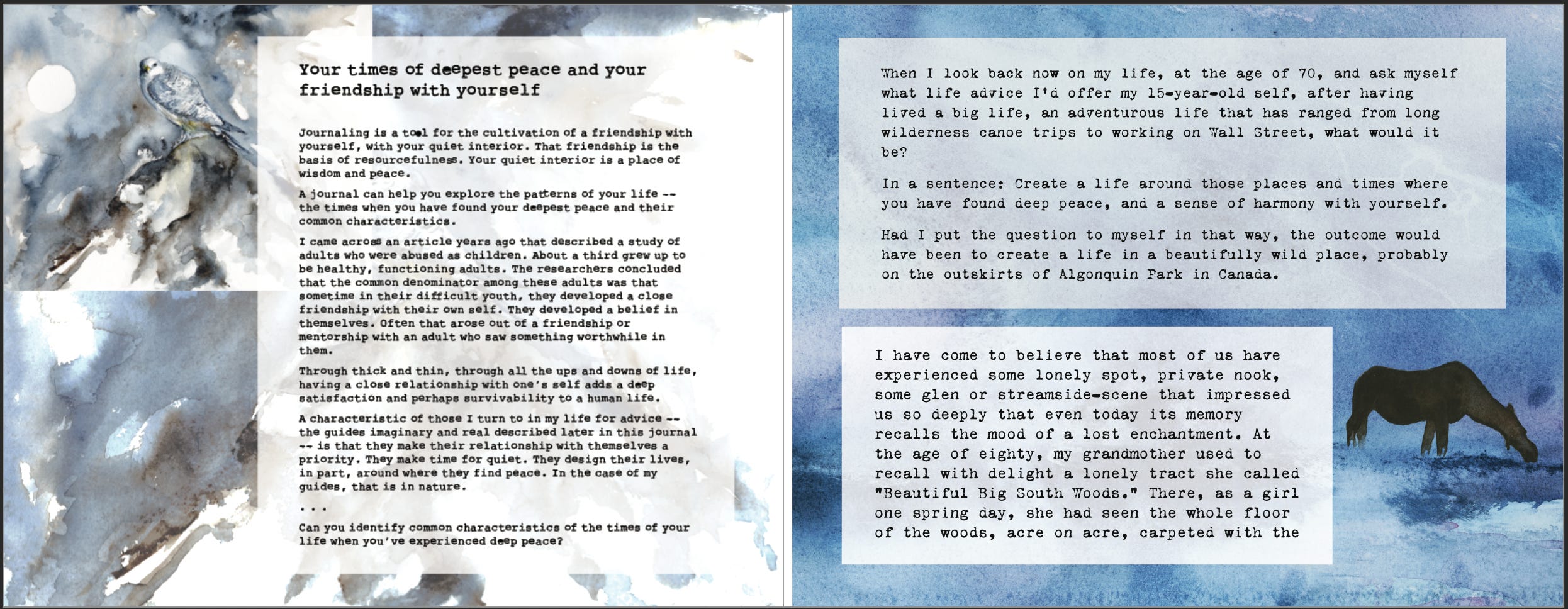
When I look back now on my life, at the age of 70, and ask myself what life advice I’d offer my 15-year-old self, after having lived a big life, an adventurous life that has ranged from long wilderness canoe trips to working on Wall Street, what would it be?
In a sentence: Create a life around those places and times where you have found deep peace, and a sense of harmony with yourself.
Had I followed that advice over the ensuing years, I would have created a life in a beautifully wild place, probably on the outskirts of Algonquin Park in Canada.
. . .
The Beautiful Big South Woods
I have come to believe that most of us have experienced some lonely spot, private nook, some glen or stream-side scene that impressed us so deeply that even today its memory recalls the mood of a lost enchantment. At the age of eighty, my grandmother used to recall with delight a lonely tract she called “Beautiful Big South Woods.” There, as a girl one spring day, she had seen the whole floor of the woods, acre on acre, carpeted with the blooms of bloodroot and spring beauties and blue and pink hepaticas. She had seen the woods only once but she never forgot it.
Walden Pond
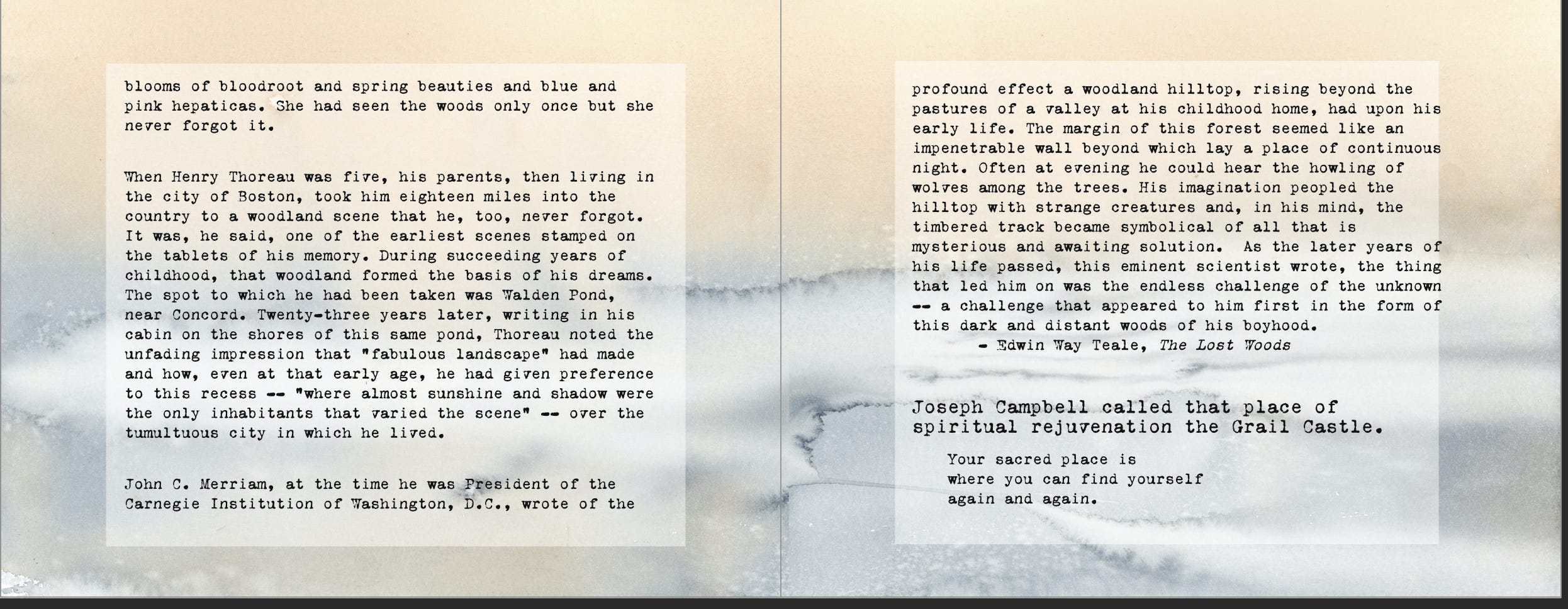
When Henry Thoreau was five, his parents, then living in the city of Boston, took him eighteen miles into the country to a woodland scene that he, too, never forgot. It was, he said, one of the earliest scenes stamped on the tablets of his memory. During succeeding years of childhood, that woodland formed the basis of his dreams. The spot to which he had been taken was Walden Pond, near Concord. Twenty-three years later, writing in his cabin on the shores of this same pond, Thoreau noted the unfading impression that “fabulous landscape” had made and how, even at that early age, he had given preference to this recess -- “where almost sunshine and shadow were the only inhabitants that varied the scene” -- over the tumultuous city in which he lived.
The Dark and Distant Woods of His Boyhood
John C. Merriam, at the time he was President of the Carnegie Institution of Washington, D.C., wrote of the profound effect a woodland hilltop, rising beyond the pastures of a valley at his childhood home, had upon his early life. The margin of this forest seemed like an impenetrable wall beyond which lay a place of continuous night. Often at evening he could hear the howling of wolves among the trees. His imagination peopled the hilltop with strange creatures and, in his mind, the timbered track became symbolical of all that is mysterious and awaiting solution. As the later years of his life passed, this eminent scientist wrote, the thing that led him on was the endless challenge of the unknown -- a challenge that appeared to him first in the form of this dark and distant woods of his boyhood.
- Edwin Way Teale, The Lost Woods
Joseph Campbell called that place of spiritual connection the Grail Castle.
Your sacred place is
where you can find yourself
again and again.
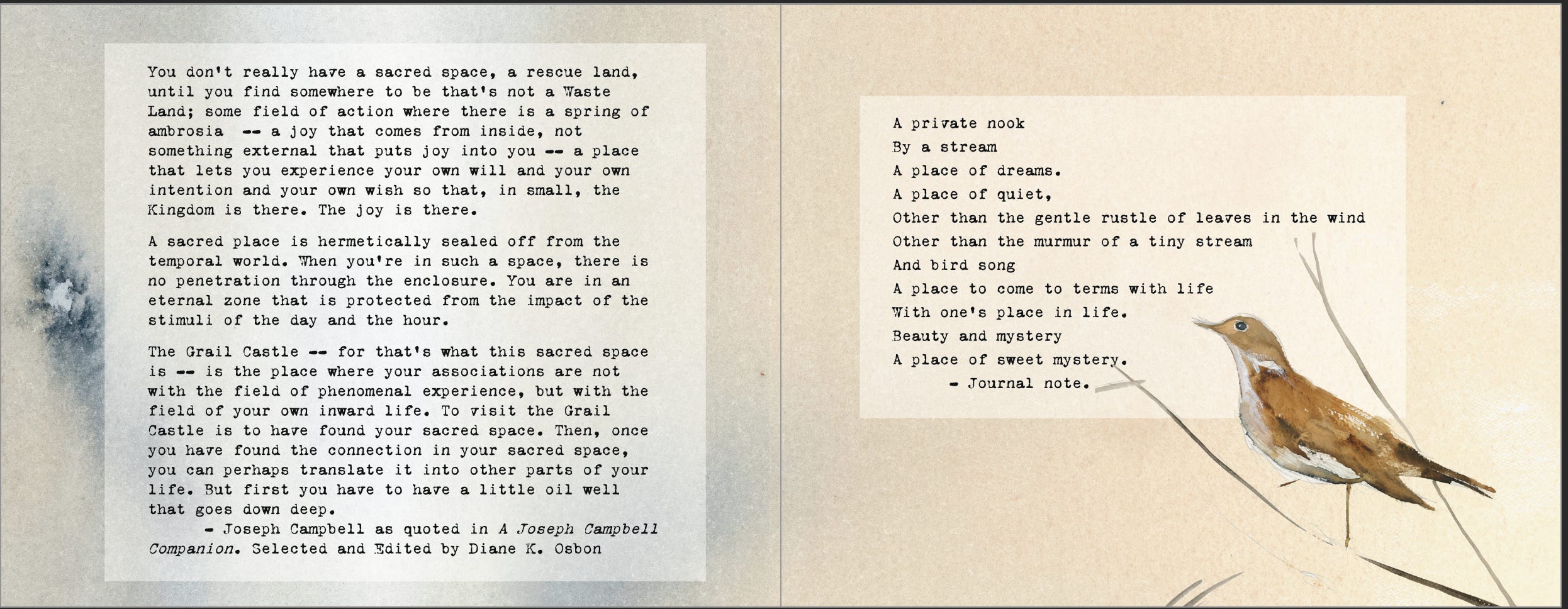
You don’t really have a sacred space, a rescue land, until you find somewhere to be that’s not a Waste Land; some field of action where there is a spring of ambrosia -- a joy that comes from inside, not something external that puts joy into you -- a place that lets you experience your own will and your own intention and your own wish so that, in small, the Kingdom is there. The joy is there.
A sacred place is hermetically sealed off from the temporal world. When you’re in such a space, there is no penetration through the enclosure. You are in an eternal zone that is protected from the impact of the stimuli of the day and the hour.
The Grail Castle -- for that’s what this sacred space is -- is the place where your associations are not with the field of phenomenal experience, but with the field of your own inward life. To visit the Grail Castle is to have found your sacred space. Then, once you have found the connection in your sacred space, you can perhaps translate it into other parts of your life. But first you have to have a little oil well that goes down deep.
- Joseph Campbell as quoted in A Joseph Campbell Companion. Selected and Edited by Diane K. Osbon
. . .
A private nook
By a stream
A place of dreams.
A place of quiet,
Other than the gentle rustle of leaves in the wind
Other than the murmur of a tiny stream
And bird song
A place to come to terms with life
With one’s place in life.
Beauty and mystery
A place of sweet mystery.
- Journal note.
. . .
Below, the corresponding pages from the new binder section, Journaling as a Tool in the Creation of a Life, which just went to the printer.
All of these options (except for the watercolor paper) are printed on heavyweight (100lb text weight) premium Mohawk Superfine, a beautiful paper for both writing and printing in color. The watercolor paper is a cotton 140lb/300 gsm weight, which is a middle weight watercolor paper.
You can order the Journal Meditations binder with the Journaling section here. The $5 discount for pre-orders will end at midnight tonight.
The whole shebang: The Journal Meditations binder, Journaling section (80 pages), watercolor paper for your art journaling (80 pages) and lined paper (80 pages) here. $89.
The softcover, wire-o bound edition (no binder necessary) here. 160 pages including 80 blank pages for your journal notes. $47.
The Journaling section on its own here. $27. (Fits a standard, off-the-shelf, 3-hole binder by punching holes along the top edge).
A PDF of the Journaling section here. (You can print onto standard 8.5 x 11 inch paper).
There are other options (the binder on its own, etc.) here.