

My follow-up interview of Bill in which he explores further his use of the term “the gods” in the context of help that shows up in his work, and his childhood and how it affected his future path.
If you don’t currently receive Zen Mountain Journal, and would like to, you can do that here.
For more on the Tao Te Ching Journal, visit here.

There are fun journeys, there are journeys of adventure and then there are magical journeys. You know you are on a magical journey when doors open when you need help most, or, when you come to a fork in the path, a guide shows up and points the way forward. It’s not that these magical journeys are easy. They transform us through trials and tribulations. We return a different person. Sometimes we start off on them for reasons we don’t fully understand. Perhaps we seek answers to questions from our childhood that have continued to trouble us.
Bill Porter is a legend to those of us who study the ancient poetry of Zen and Taoist mountain hermits. He’s lived in China for long periods of time, and can read, write and speak fluent Chinese. His book, Road to Heaven, about the present day Taoist hermits that live in China’s Zhongnan mountains has sold two million copies in China. There are hermits now living in those mountains that say they became hermits because of his book.
Bill is an unassuming, gentle man who has devoted fifty odd years of his life to studying Zen and Taoist mountain hermits and their ancient poetry. When, in our recent interview, while exploring where the motivation came from to embark upon this work, Bill talked about his decision to study anthropology after he left the army.
The reason I wanted to study anthropology when I got out of the Army was because, I thought by studying all the different ways people live their lives, I could choose one. I could put together something that made sense for me. I was trying to put my life together. My family was not something I wanted to be a part of. After my father got out of prison for bank robbery he started up a chain of hotels. He had 52 hotels when I was born, which I grew up around, and he was the head of the Democratic Party at one time in California, and then, at the end, in Idaho. I grew up around rich and famous, powerful people, and it was detestable, to live and be in the presence of people like that.
As a child, I had already chosen my path. Learning Chinese just opened up a new door to a new part of that path, and I’ve been following it ever since.
That word “detestable” kept turning over in my mind after our interview. It was the only time Bill displayed any emotion. I’ve often encountered, over the years of doing interviews, people whose life course seemed shaped by events from their childhood that were particularly profound or disturbing. Sometimes these paths were followed unconsciously, but Bill is aware of the connection. “As a child, I already chose my path.“ That path involved finding and writing about people living opposite lives to those of the family he grew up in – hermit monks focused on achieving inner peace through spiritual practice and living with almost nothing in remote mountains. When I asked Bill whether or not he thought extreme austerity was important to spiritual progress, he answered,
“It’s all about traveling light. It’s about lightening your load, getting rid of the garbage. You have a hard time surviving in the mountains. You don’t have time to be thinking about stuff. You hone in on what’s important in your practice, ‘cause you have to feed yourself. You have to grow vegetables. You have to gather wild plants. And of course, you have to either build or fix up somebody else’s hut.”
Bill didn’t start out with an interest in Taoist and Zen hermits or their poetry. A series of strange coincidences led him in that direction. Broke and attending Columbia to study anthropology on the GI Bill, he applied for several different grants for financial assistance. One, from the Defense Department, offered four years of support to students willing to learn a language not commonly spoken in the US. On a whim, without ever having had any interest in Chinese but also not having any interest in any other language, he wrote in Chinese and continued filling out other unrelated applications. A short while later he received a letter from the Defense Department accepting his application and giving him the financial support he needed to continue at Columbia.
After beginning the study of Chinese he happened to meet in New York City’s Chinatown a Zen monk who couldn’t speak English. Bill’s knowledge of Chinese was rudimentary at that point, but good enough that the monk was able to teach Bill meditation. A few months later Bill decided to go a monastery to practice meditation – and learn more about the spiritual practice of the monk that had become his friend. He wasn’t interested in becoming a monk himself – he’s always had a problem with authority he says – but he lived in two monasteries for a total of three and a half years. They wouldn’t accept money from him, which was good, he said, because he didn’t have any. The next fortuitous event in his journey happened as he was getting ready to depart the second monastery. The abbot gave him a book, written in Chinese characters, on the poetry of Cold Mountain, otherwise known as Han Shan.
Bill became enthralled by this poetry written by a hermit monk who lived around 800 AD. Rather than being written in academic, scholarly language, it was written in the simple vernacular of common people. For the next fourteen years, Bill lived in a farming village outside of Taipei and studied the poetry of Han Shan and then of another mountain hermit, Stonehouse. He’d get odd jobs to support himself and eventually ended up working at an English language radio station interviewing leading Taiwanese figures who could speak at least a little English. There, he had an interesting conversation with Winston Wong, who Bill describes as the head of the largest plastics company in the world, Formosa Plastics. It opened the next important door on Bill’s journey.
After having translated the poetry of both Han Shan and Stonehouse, Bill wanted to travel to China to see if he could find and connect with present-day mountain hermits. The official stance of the Chinese government was that they no longer existed. Bill, though, had heard rumors. He just had no idea where they were. He applied for a grant from the Guggenheim to go and try to find them.
As the interview was concluding, Bill asked Winston Wong if he had seen the movie The Graduate, and Winston responded that he had. From my interview of Bill:
“And I said, ‘So what would you tell a graduate? Would you tell him, ‘Plastics, son, plastics?’ He said, ‘No, no, I would tell him to follow the Tao.’ I was impressed with that answer so I told him that I’d applied to the Guggenheim Foundation to go to China to find hermits. And he said, ‘That’s a great idea. If they don’t give you the money, I will.’ A couple weeks later, I got a letter of rejection from the Guggenheim. I called him on the phone, and he said, ‘How much do you need?’ About four or five thousand dollars, he said, ‘Do you want that in cash or traveler’s checks?’
I went down to his office later that day, picked up traveler’s checks. That’s how I got started on the quest for hermits.”
Bill left for China, still having no idea where the hermits, if they existed, might live. A monk Bill encountered told him that there might be hermits in the Zhongnan mountains. Not having any other better ideas, Bill headed there and started to climb. That first trip was roughly 1987. Six years later Bill’s book, Road to Heaven, was published.
He continued to make trips there into his seventies. In videos on YouTube (my favorite can be found here), Bill, not in mountaineering shape, trudges up narrow mountain paths, sometimes with a sheer cliff falling off the trail to one side. He approaches the simple huts and knocks on their door. Sometimes they answer, sometimes they don’t. When they do, and agree to an interview, Bill approaches asks them questions slowly, with obvious respect. His desire to learn from them is evident. They share what they can, but, as he says, they struggle to communicate a spirituality that transcends words. From our interview:
“Words were not what they were looking for in the first place. They were all working on an inner spiritual reality, you might say. . . That’s why I really like poetry better than prose, for this kind of realm. Because poetry uses words to transcend words. These people like Cold Mountain and Stonehouse were really adept at delivering the spirit without letting words get in the way.”
Bill’s journey to find, understand and write about hermits has been one of both help showing up when he needed it, and knew he needed it, and inadvertent opportunities that led him in directions he didn’t know he wanted to go. He went about his quest with a remarkable lack of ambition or striving. If doors opened, he walked through them. His gentle approach reminds me of the Taoist principle of wu-wei – effortless action -- acting without unnecessary force, strain, or ego-driven struggle. As he says, “one thing leads to another, and I’ve kept down this path of where I’m not doing something to become rich and famous, but because it is something I want to do.”
When I suggested to him that this life he’s chosen required a price, he said no, not really. He just got on a path that seemed interesting to him and followed it. That’s a little ironic in the context of something else he said later in the interview – for eighteen years after returning to the US he and his family lived on food stamps. Eventually royalties from his books enabled him to move “out of the world of food stamps and into the realm of the tax-paying lower-middle class.” Sacrifice or no, out of all of this has come a formidable body of work, and one I frequently turn to in my own study of the ancient poems of the Zen and Taoist mountain hermits.
. . .
Here’s one of my favorite excerpts from Bill’s book, Road to Heaven, Encounters with Chinese Hermits in which Bill interviews Master Hsieh, a Taoist monk, living on China’s Huashan Mountain.
Hsieh: Lao-tzu said to cultivate tranquility and detachment. To be natural. To be natural means not to force things. When you act natural, you get what you need. But to know what’s natural, you have to cultivate tranquility. Huashan has long been famous as a center of Taoism because it’s quiet. There used to be a lot of hermits here. But now the mountain has been developed for tourism. The tranquility is gone, and so are the hermits.
Porter: Aren’t they interested in teaching others?
Hsieh: Yes. But before you can teach others, you have to cultivate yourself. You have to know something before you can teach something. You can’t explain inner cultivation just because you know words in books. You have to discover what they mean first.
Porter: If people can’t learn Taoism from hermits, can they learn from monks in temples?
Hsieh: You can’t learn just by visiting a temple. You have to live there for at least three years and help with the daily work. If you can stand the hardship and privation, after three years you can ask one of the monks to be your teacher. It’s not easy. You have to have a clear head and a quiet mind. As I said before, it takes at least three years of physical training before your mind is quiet enough to understand the Tao.
You can read more of my favorite excerpts from Bill’s writing here.
. . .
You can another, earlier version, of this post on the Zen Mountain Journal website here. It offers my takes on the interview from a slightly different perspective — the Joseph Campbell’s mythic hero’s journey.
You can learn more about the Zen Mountain Journal and Heron Dance here.
The Tao Te Ching Journal:
A Path to Inner Quiet
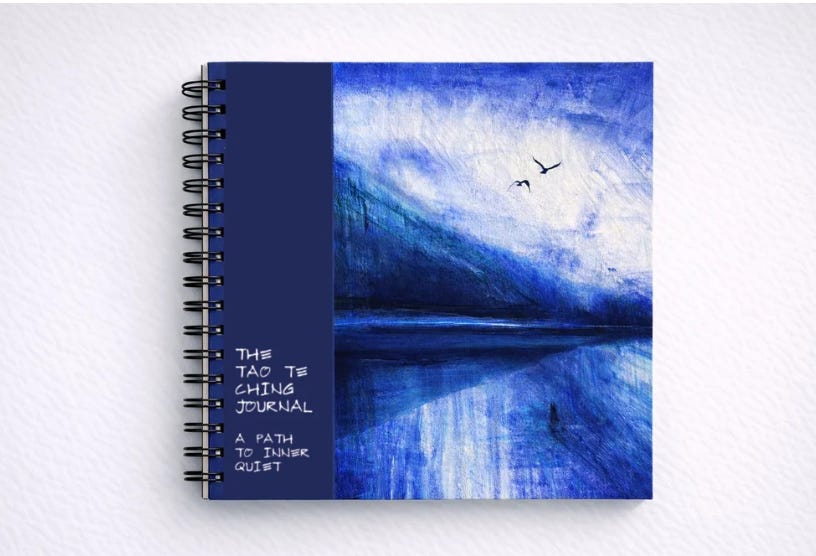
Zen Mountain Journal blends Taoist hermit poetry, contemplative art, and reflections drawn from a lifetime shaped by wilderness, solitude, and decades doing creative work on the outer boundaries of our culture. These journals are companions for seekers — guides in the reconnection with inner quiet, beauty, and the “soundless music” of a life lived with simplicity and meaning.
• Size: 9.25 × 8.5 inches — convenient size for desk or lap.
• Hardcover — the book can be written in without a table or desk.
• Double wire-o bound to lay flat.
• Printed on Mohawk Superfine, a premium uncoated paper for a beautiful writing surface.
• 160 pages.
Loved to read this
Thanks for letting me know Ell.
I'm working on the next one and hope to have it out by the end of the day today.